

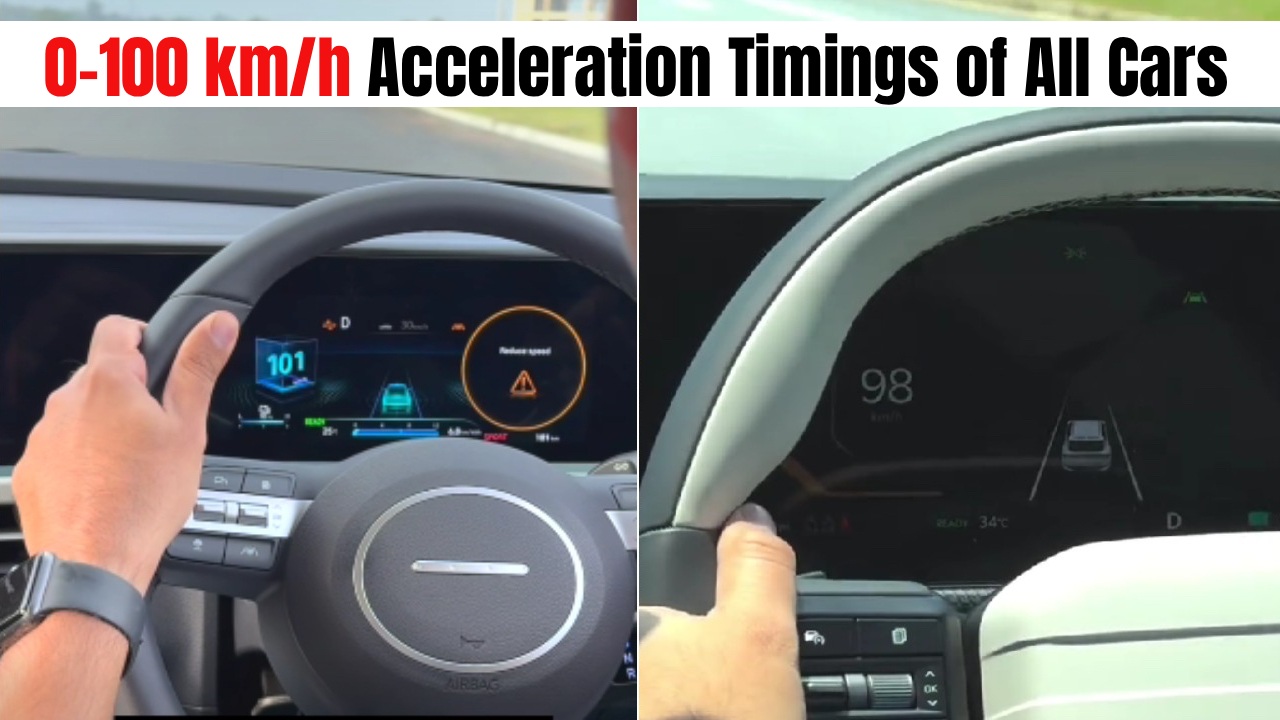
Such acceleration tests often depict the performance of any car in a straight line, which can easily be compared to other cars
In this post, we are compiling prominent mainstream passenger cars with their 0-100 km/h acceleration times. In the last few years, we have seen a surge in content creators and top media houses conducting such tests to compare the acceleration of cars. These can be vehicles from the same segment or even from different segments. In fact, it could even depend on the kind of engines each car possesses. Let us check out how these automobiles fared on our test.
0-100 km/h Acceleration Tests of Cars
Mahindra XUV 7XO
The new Mahindra XUV 7XO is the most recent vehicle on this list. It comes with a 2.0-litre mStallion turbo-petrol and a 2.2-litre mHawk turbo diesel mill, producing 200 hp / 380 Nm and 155 hp / 360 Nm (and 185 hp / 420 Nm) of peak power and torque, respectively. With automatic transmission, the diesel car makes 450 Nm. In our test, we took the petrol automatic. It took just 4.21 seconds to reach 60 km/h from a standstill, 6.23 seconds to reach 80 km/h, 10 seconds to accomplish 100 km/h and just 13.14 seconds to cross 120 km/h. These are impressive figures for a vehicle of this size.
Maruti Suzuki e Vitara
The latest vehicle that we conducted a 0-100 km/h acceleration test on is the Maruti Suzuki e Vitara. It is the first electric vehicle from Suzuki globally. Hence, a lot is riding on it. It comes with a 49 kWh or 61 kWh battery pack with the maximum claimed range of 543 km on a single charge with the latter. The power and torque figures are 142 hp / 189 Nm, 172 hp / 189 Nm and 181 hp / 300 Nm (AWD), respectively. In our recent test, the acceleration from 0 to 100 km/h came up in 9.14 seconds, while the EV clocked 120 km/h in 12.21 seconds. I feel, these are not too exciting numbers for an electric car.
Mini Convertible
The Mini Convertible bears the tag of being the most affordable convertible in the country. It comes with a familiar 2.0-litre turbo petrol mill, which churns out a healthy 204 hp and 300 Nm of maximum power and torque, respectively. This engine pairs with a 7-speed DCT automatic. Its key attraction is the electrically-operated soft top, which fully retracts in just 18 seconds even at speeds of up to 30 km/h. During our test run, it was able to clock the 100 km/h acceleration from a standstill in just 7.07 seconds, while the 120 km/h mark was breached in 9.17 seconds. These are pretty decent numbers.
Mahindra XEV 9S
The latest vehicle on this list is the Mahindra XEV 9S. It is the INGLO-based 7-seat electric SUV, which comes with three battery packs – 59 kWh, 70 kWh and 79 kWh. In the most aggressive settings, it generates an impressive 285 PS and 380 Nm of maximum power and torque, respectively. In the testing, the large electric SUV was able to clock a speed of 100 km/h from a standstill in just 7.07 seconds, which is quite impressive for a 7-seat SUV. The main reason for this exhilarating performance is the inherent torque associated with electric powertrains.
Hyundai Venue
The latest Hyundai Venue is the first vehicle on this list. During the media review, we got the opportunity to drive the new Venue with the 1.0-litre 3-cylinder turbo petrol mill with the 7-speed DCT gearbox. This engine makes 120 PS and 172 Nm of peak power and torque, respectively. In our testing, the compact SUV clocked the speed of 60 km/h from a standstill in just 5.12 seconds, 80 km/h from a standstill in 8.03 seconds and reached 100 km/h in an impressive 11.22 seconds. This is at par with what most rivals in this segment offer.
Maruti Brezza
Next up, we have the Maruti Brezza, which is a direct rival to the Hyundai Venue. As a part of our drive review, we operated the compact SUV with a 1.5-litre 4-cylinder naturally aspirated petrol engine with an automatic transmission. It produces a familiar 103 PS and 137 Nm of maximum power and torque, respectively. After finding an open stretch of road, we accelerated the Brezza as hard as we could. As a result, we achieved a 0-100 km/h acceleration time of 13.32 seconds. For an NA petrol mill, this is acceptable.
Maruti Victoris
Then we have the new Maruti Victoris on this list of cars with 0-100 km/h acceleration times. Victoris is a mid-size SUV sold under the Arena arm of Maruti Suzuki. It comes with multiple powertrain options, but we got behind the wheel of the 1.5-litre NA petrol mill with a 5-speed manual transmission. This mill produces a healthy 103 PS and 139 Nm of peak power and torque, respectively. We stretched it to its limits and achieved an acceleration time of 6.23 seconds to reach 60 km/h, 10 seconds to reach 80 km/h, 14.17 seconds to reach 100 km/h and 20.12 seconds to reach 120 km/h from a standstill.
Renault Kiger
The Renault Kiger is a famed compact SUV which rivals the likes of the Tata Punch and Hyundai Exter in our market. It has been one of the major contributors to the overall sales of the French car marque. We got the opportunity to drive the Kiger in its 1.0-litre turbo petrol guise, which is good for 100 PS and 160 Nm of peak power and torque, respectively. This mill pairs with a CVT automatic gearbox. We accomplished a 0-60 km/h acceleration time of 5.26 seconds, 0-80 km/h time of 8.22 seconds, and a 0-100 km/h acceleration time of an impressive 12.17 seconds.
MG Cyberster
Next up, we have one of the most gorgeous-looking electric sports cars around on this list as well. MG entered the premium luxury segment in India with the likes of the Cyberster and M9. These automobiles are sold exclusively via the MG SELECT dealerships across the nation. The EV carries a 77 kWh battery pack, which powers two electric motors for an all-wheel-drive configuration. These generate a colossal 510 PS and 725 Nm of maximum power and torque, respectively. In our test run on a track, we were able to hit 100 km/h from a standstill in just 3.21 seconds, while the 200 km/h mark came up in just 13.21 seconds. These are some serious numbers and put it in the league of some ultimate sports cars from the Italian carmakers.
Kia Carens Clavis EV
Let us now move on to the Kia Carens Clavis EV. It is the new electric iteration of the Carens MPV. Loaded with tons of new-age amenities, the electric MPV gained instant traction in India. It is available with two battery pack options – 51.4 kWh and 42 kWh. In its most aggressive settings, the power and torque figures are 171 PS and 255 Nm, respectively. At the time of the media drive, we decided to put that inherent instant torque to the test. Consequently, we were able to achieve a 0-100 km/h acceleration time of just 8 seconds, which is quite impressive for a 3-row MPV.
Kia EV9
The Kia EV9 is yet another prominent electric vehicle from the Korean auto giant in India. Note that it is the flagship model from Kia and costs a whopping Rs 1.30 Crore, ex-showroom. Filled with the latest in-cabin amenities and the latest technology, the EV9 uses a colossal 99.8 kWh battery pack. It powers two electric motors for an all-wheel-drive configuration. However, the biggest talking point has to be the 379 hp and 700 Nm of peak power and torque, respectively. In our test, we reached 80 km/h from a standstill in 3.20 seconds, 100 km/h in 5.06 seconds and 120 km/h in just 7.06 seconds. For a colossal 3-row electric SUV, these are some pretty impressive numbers.
BMW iX1 LWB
To cater to the opulent sections of society, the German carmaker offers the iX1 electric SUV in the LWB (Long Wheelbase) format in our market. The aim is to make the rear occupants as comfortable as possible. It packs in a 66.4 kWh battery pack, which powersan electric motor to generate a healthy 204 hp and 250 Nm of peak power and torque, respectively. Since it prioritizes comfort and practicality over everything else, the performance is not aggressive. During our media drive, we clocked a 0-100 km/h acceleration time of just 8.18 seconds and even took it to 120 km/h, which came up in 11.18 seconds.
Kia Syros
The Kia Syros is a unique proposition for the Indian market by virtue of belonging to a rather niche market segment. It sits between the Sonet compact SUV and the Seltos mid-size SUV. It is available in multiple powertrain options, including a 1.0-litre 3-cylinder turbo petrol and a 1.5-litre 4-cylinder turbo diesel mill, which outputs 120 PS / 172 Nm and 116 PS / 250 Nm of maximum power and torque, respectively. In its most aggressive settings, we were able to post a 0-80 km/h acceleration time of just 7.15 seconds, a 0-100 km/h time of 11.02 seconds and 120 km/h came up in a respectable 15.22 seconds.
Skoda Kylaq
Skoda Kylaq competes in one of the most crowded market segments in India, the compact SUV category. We have models from just about every major mass market car marque in this space. For our testing, we took the 1.0-litre turbo petrol mill with an automatic transmission. This combination generates a rather healthy 115 PS and 178 Nm of maximum power and torque, respectively. We accomplished a prominent 0-100 km/h acceleration time of just 13.09 seconds. This is a decent outcome for a vehicle of this segment.
Hyundai Creta Electric
Hyundai sells the Creta in an electric guise in India as well. Levering the resounding success of the Creta moniker, the Korean auto giant decided to offer it with an electric heart as well. It comes with two battery pack options – 42 kWh and 51.4 kWh. In the most powerful settings, the electric motor churns out 171 hp and 255 Nm of peak power and torque, respectively. When we took it out for a drive on an empty stretch of road, we reached 60 km/h from a standstill in just 4.15 seconds, 80 km/h in 6.08 seconds, 100 km/h in 8.13 seconds and 120 km/h in an impressive 11.10 seconds. We see such figures on a mass market mid-size courtesy of the inherent torque associated with EVs.
Mahindra BE 6
The Born Electric SUVs from Mahindra gained traction ever since they were showcased last year. The sales numbers have been great. The BE 6 comes with a 59 kWh or 79 kWh battery pack and is based on the INGLO architecture. In the most aggressive settings, the electric SUV produces 281 hp and 380 Nm of maximum power and torque, respectively. We tested it in all three modes – Range, Everyday and Race. The 0-100 km/h accelerations times are representative of these modes. We achieved 11.12 seconds, 7.10 seconds and 7.03 seconds, respectively. The instant torque delivery of EV comes to the fore here.