

The electric SUV space is getting crowded rapidly as customers get more and more options to choose from
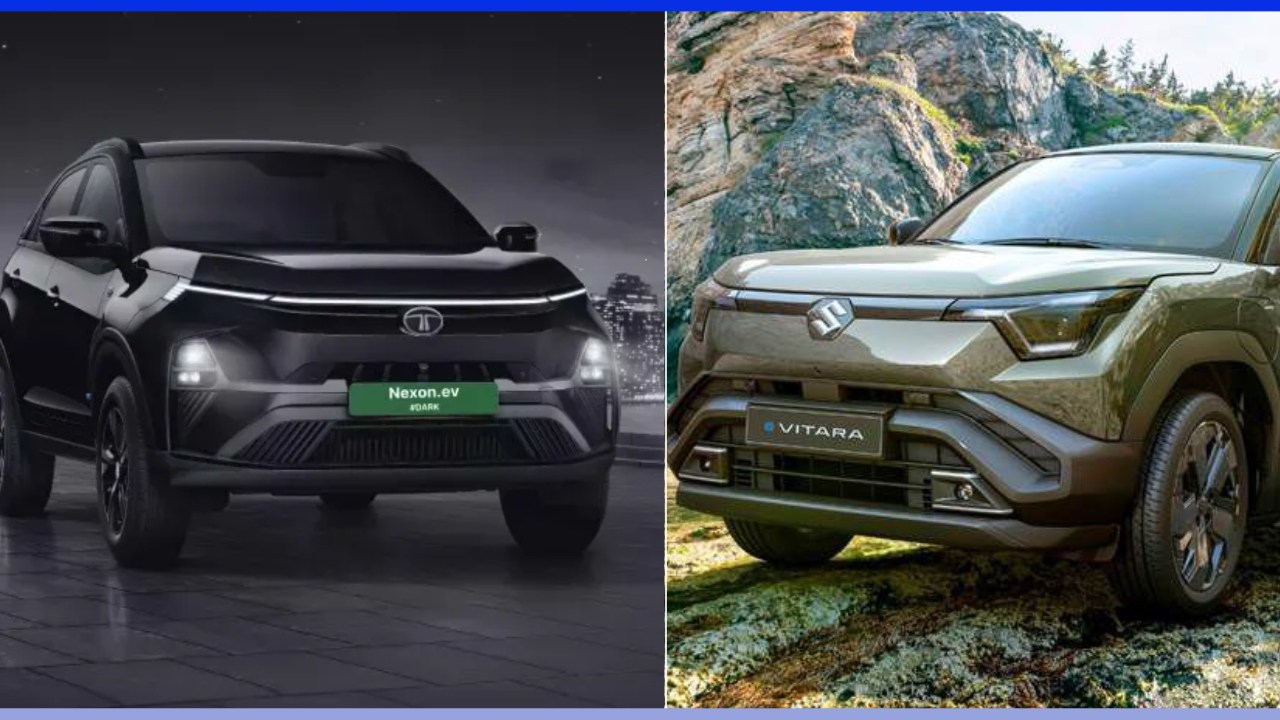
In this post, we compare the new Maruti e Vitara and the Tata Nexon EV on the basis of price, specs, features, design, etc. This is a hotly contested market space in India. The Nexon EV has been the most successful EV in the country and also one of the earliest models. Leveraging the popularity of its ICE counterpart, the Nexon EV continues to sell in high numbers. On the other hand, the e Vitara represents the first electric car from Maruti Suzuki. Hence, it would like to grab some market share away from the Nexon EV. For now, let us compare the two thoroughly.
Maruti e Vitara vs Tata Nexon EV – Price Comparison
The new Maruti e Vitara comes with the BaaS (Battery-as-a-service) program, which lowers the initial costs significantly. With BaaS, the introductory prices start at Rs 10.99 lakh + Rs 3.99 per km battery rental. Additionally, the company is offering 60% assured buyback option after 3 years, along with an 8-year warranty on the battery. Furthermore, Maruti will give the customers a complimentary home charger and installation worth Rs 50,000 and complimentary charging for 1 year. For versions without BaaS, the prices range between Rs 15.99 lakh and Rs 19.79 lakh, ex-showroom. On the other hand, the Tata Nexon EV retails between Rs 12.49 lakh and Rs 17.49 lakh, ex-showroom.
| Prices (ex-sh.) | Maruti e Vitara | Tata Nexon EV |
| Base Model | Rs 10.99 lakh + Rs 3.99 per km (BaaS); Rs 15.99 lakh (w/o BaaS) | Rs 12.49 lakh |
| Top Model | Rs 19.79 lakh (w/o BaaS) | Rs 17.49 lakh |
Maruti e Vitara vs Tata Nexon EV – Specs Comparison
Let us commence with the Maruti e Vitara. The electric SUV is built on the new HEARTECT-e architecture and offers two battery choices – 49 kWh and 61 kWh. The electric SUV can be had in a single-motor front-wheel-drive layout, although the international model is on offer with a dual-motor AWD guise too. Power and torque figures span from 142 hp / 193 Nm to 181 hp / 193 Nm. Maruti states that the larger battery pack can deliver a driving range of 543 km on a full charge, while the smaller battery pack is good for 440 km. Moreover, with a ground clearance of 180 mm, it should tackle typical Indian road conditions and speed breakers without much difficulty.
In comparison, the Tata Nexon EV comes in two variants. These are the Medium Range (MR) featuring a 30.2 kWh battery and the Long Range (LR) equipped with a larger 40.5 kWh unit. The claimed range is 325 km for the MR and 465 km for the LR on a full charge. That said, actual range may differ depending on driving style and external conditions. Power and torque outputs vary from 127 hp and 215 Nm to 143 hp and 215 Nm based on the chosen version. Importantly, the higher-spec model can accelerate from 0 to 100 km/h in just 8.6 seconds. With a DC fast charger, the battery can be replenished from 10% to 100% in roughly 56 minutes. Overall, the performance of both EVs remains broadly similar.
| Specs | Maruti e Vitara | Tata Nexon EV |
| Battery | 49 kWh & 61 kWh | 30.2 kWh & 40.5 kWh |
| Range | 440 km & 543 km | 325 km & 465 km |
| Power | 142 hp – 181 hp | 127 hp & 143 hp |
| Torque | 193 Nm | 215 Nm & 215 Nm |
| DC Fast Charging | 10-80% in 45 mins | 10% to 100% in 56 minutes |
| Ground Clearance | 180 mm | 190 mm |
Maruti e Vitara vs Tata Nexon EV – Features, Tech and Safety Comparison
Today’s customers want the absolute top-notch tech and convenience amenities in their vehicles. As a result, we see carmakers equip their models with all the bells and whistles. Some of the top in-cabin highlights of the e Vitara include:
- 10.2-inch Digital Instrument Cluster
- 10.1-inch Touchscreen Infotainment Display
- Physical Controls for HVAC and Multimedia
- Electric Sunroof
- Rear USB Ports
- Retractable Rear Seats
- Stylish AC Vents
- Soft-touch Materials
- Multi-colour Ambient Lighting
- Infinity Premium Sound System
- Ventilated Front Seats
- 10-way Powered Seats
- Sliding and Reclining Rear Seats
- 12-colour Ambient Lighting
- Drive Modes – Eco, Normal, Sport
- All-disc Brakes with Twin Piston Callipers in Front
- 306-litre Boot Space (w/ rear row pushed forward)
- 60+ Advanced Telematic Features
- Two-spoke Steering Wheel
- Leatherette Bucket Seats
- Rotary Shift Knob
- 750 kg Towing Capacity
- 2-spoke Steering Wheel with Controls
- Level 2 ADAS
- 5-star Bharat NCAP Safety Rating
- 7 Airbags
- ABS, ESP, EBD
- High Tensile Steel
- Hill Hold Control
- Multi-Collision Braking
- 360-degree Surround View Camera
- Front and Rear Parking Sensors
- Day and Night Adjustable IRVM
On the other hand, the Tata Nexon EV is also loaded with features to the brim. The main highlights are:
- 12.3-inch Cinematic Touchscreen Infotainment Display by HARMAN
- Illuminated Two-spoke Steering Wheel
- Customizable 10.25-inch Digital Instrument Cluster with Navigation
- 360-degree Camera
- Ventilated Front Seats
- Single-pane Sunroof
- Wireless Charging
- Connected Car Tech
- JBL Sound System
- Voice Commands
- Air Purifier
- OTA Updates
- Arcade EV App Suite for Streaming OTT Platforms like Prime Video and Disney+ Hotstar
- 5-star Bharat NCAP Rating
- V2L and V2V Technology
- Blind Spot Monitoring
- Air Purifier with AQI Display
Design and Dimensions Comparison
The Maruti Suzuki e Vitara carries a contemporary design while retaining a somewhat familiar visual language. Up front, it features prominent LED lighting with LED DRLs, a sporty bumper with fog lamps, a closed grille section and a smoothly contoured bonnet. Along the sides, the dual-tone aero alloy wheels, muscular body panels, rugged cladding around the wheel arches, and blacked-out pillars stand out. The profile lends the EV a strong and commanding stance on the road. At the rear, there are LED taillamps linked by a black trim element, a roof-mounted spoiler, a shark-fin antenna and a robust bumper. Overall, the SUV appears bold and well-proportioned, even if it is slightly smaller than the Hyundai Creta Electric.
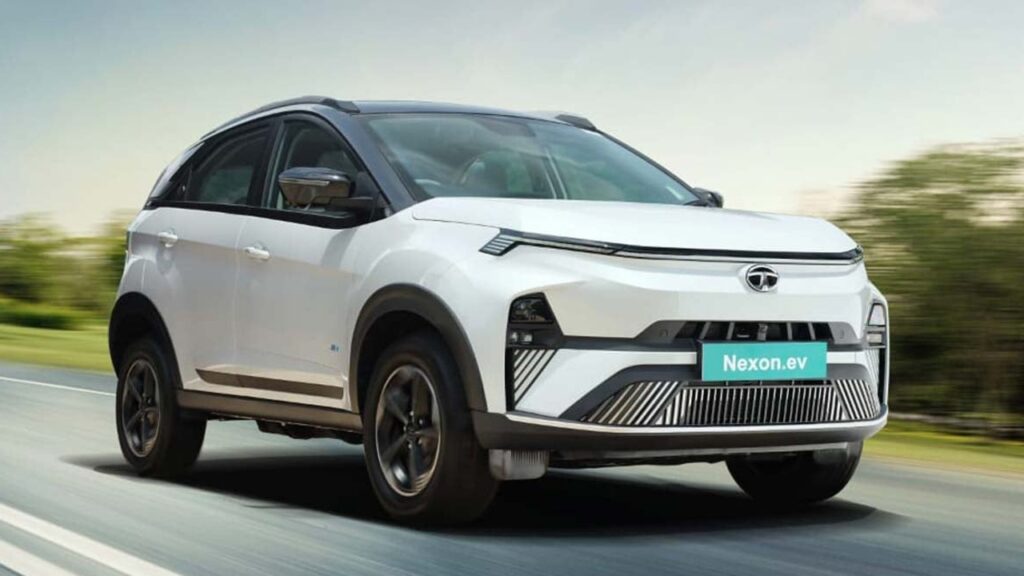
In contrast, the Tata Nexon EV also incorporates plenty of contemporary styling cues. The front fascia is defined by a slim LED light bar, while the primary LED headlamps sit lower on the bumper. The bumper itself carries a distinctive design pattern, which adds character. Along the sides, there are blacked-out pillars, pronounced wheel arches, aero alloy wheels and faux roof rails. At the rear, the design is rounded off with a roof-mounted spoiler, a shark-fin antenna and a connected LED taillamp with a light bar. A sporty bumper with a dedicated skid plate and reflector elements on the edges completes the look. Both EVs clearly maintain their own visual identities.
| Dimensions (in mm.) | Maruti Suzuki e Vitara | Tata Nexon EV |
| Length | 4,275 | 3,995 |
| Width | 1,800 | 1,802 |
| Height | 1,635 | 1,625 |
| Wheelbase | 2,700 | 2,498 |
Editor’s Note
Yatharth Chauhan, Managing Editor
From my perspective, this comparison signals a pivotal shift in India’s EV landscape. Tata has enjoyed a first-mover advantage with the Nexon EV, but Maruti’s entry, backed by its vast sales and service network, has the potential to reshape buyer confidence in electric mobility. The BaaS model could be a game-changer for cost-sensitive customers who are still hesitant about high upfront EV prices. However, Tata’s strong brand recall in the EV space and proven real-world ownership experience will continue to weigh heavily in purchase decisions. Ultimately, this battle will be won not just on specs, but on ecosystem, trust and total cost of ownership.
Also Read: New Mahindra XUV 3XO EV vs Tata Nexon EV – Which Compact EV To Buy?