

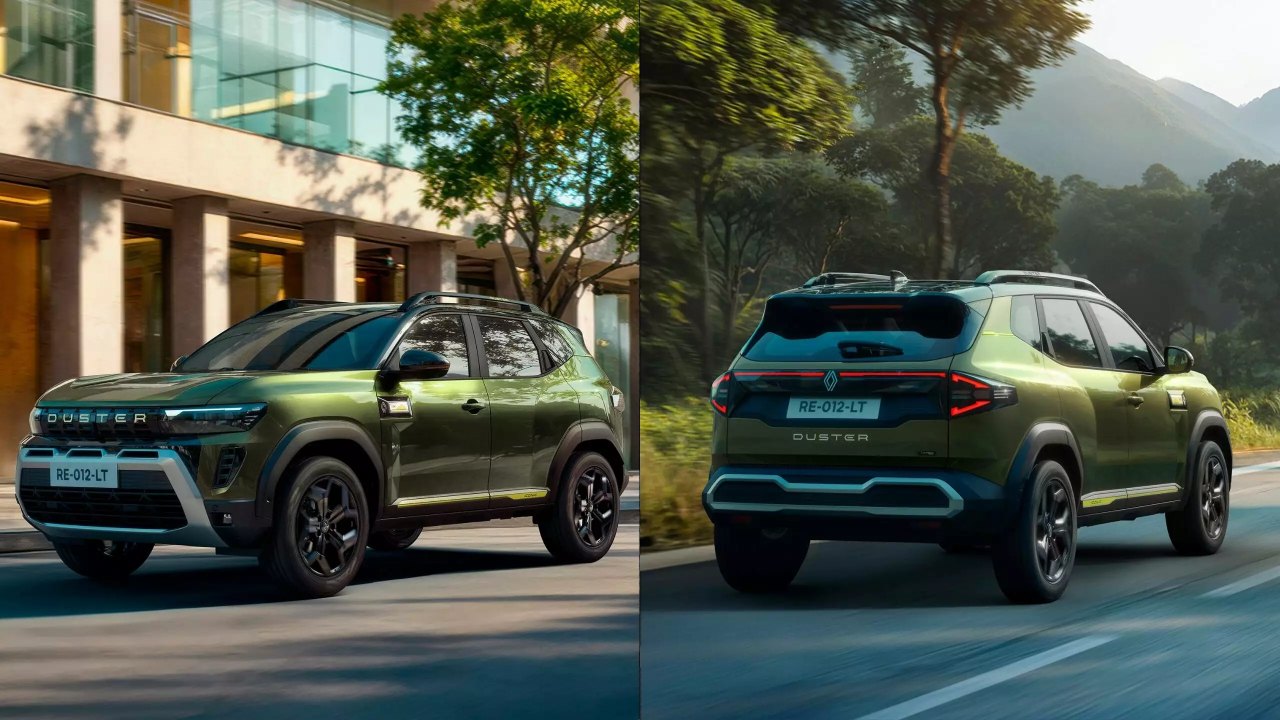
The new-gen Renault Duster is slated to launch in India on March 17, 2026, to shake up the mid-size SUV segment
In this post, we take a look at the details of the key differences and similarities between the India-spec and Euro-spec Renault Duster. Duster has been a key product in the French car marque’s Indian portfolio. It led to the creation of the mid-size SUV space in India back in 2012. It remained in production until 2022. By this time, there were numerous models on sale in this space. However, the 3rd-generation Duster is now back with tons of new-age styling and tech. For now, let us check out the characteristics of the new platform.
India-spec New Renault Duster vs Euro-spec
Note that the European Renault Duster is underpinned by the CMF-B architecture, while the Indian model uses the RGMP architecture. The latter is designed using localized materials. Also, it has more modular traits, enabling more body types, size and powertrains to be incorporated, while remaining more affordable. Another key advantage of the RGMP system is the SWEET400 (SoftWare Electric and Electronic Technology), co-developed with Google.
It is a completely new electronic framework for easy integration of the advanced digital features and software-driven functions. The users can log in using their Google IDs and get customized profiles for enhanced convenience. Also, the Indian Duster is 50 mm taller than the European model, which ensures the accommodation of the panoramic sunroof. Other bits include the unique Duster grille, fog lamps, powered tailgate, leatherette seats with Google Infotainment and different powertrain options.
Apart from that, the RGMP architecture supports cars with varying sizes (wheelbase from 2,632 mm to 2,748 mm), body shapes (5-, 6-, and 7-seat options) and powertrain options (including electrified powertrains). This means vehicles ranging from less than 4m in length to C-segment cars with lengths of up to 4.7m. Additionally, multiple engines and transmissions can be incorporated into this architecture, along with 2WD and 4WD configurations. In terms of front overhangs, cars can be anywhere between 780 mm and 860 mm, while the rear overhangs can be up to 1,020 mm. Hence, the RGMP focuses more on modularity and flexibility, which is great to expand the footprint in a country like India and other emerging markets.
Editor’s Note
Yatharth Chauhan, Managing Editor
In my view, Renault clearly understands that the new Duster cannot succeed in India with a one-size-fits-all global approach. By developing the RGMP architecture specifically for emerging markets, the brand is attempting to balance modern technology with the cost sensitivity of Indian buyers. If Renault manages to combine the Duster’s iconic rugged appeal with a highly modular and tech-friendly platform, it could once again become a serious contender in the fiercely competitive mid-size SUV segment.
Also Read: New Renault Duster vs Skoda Kushaq – Which New SUV is Better?