

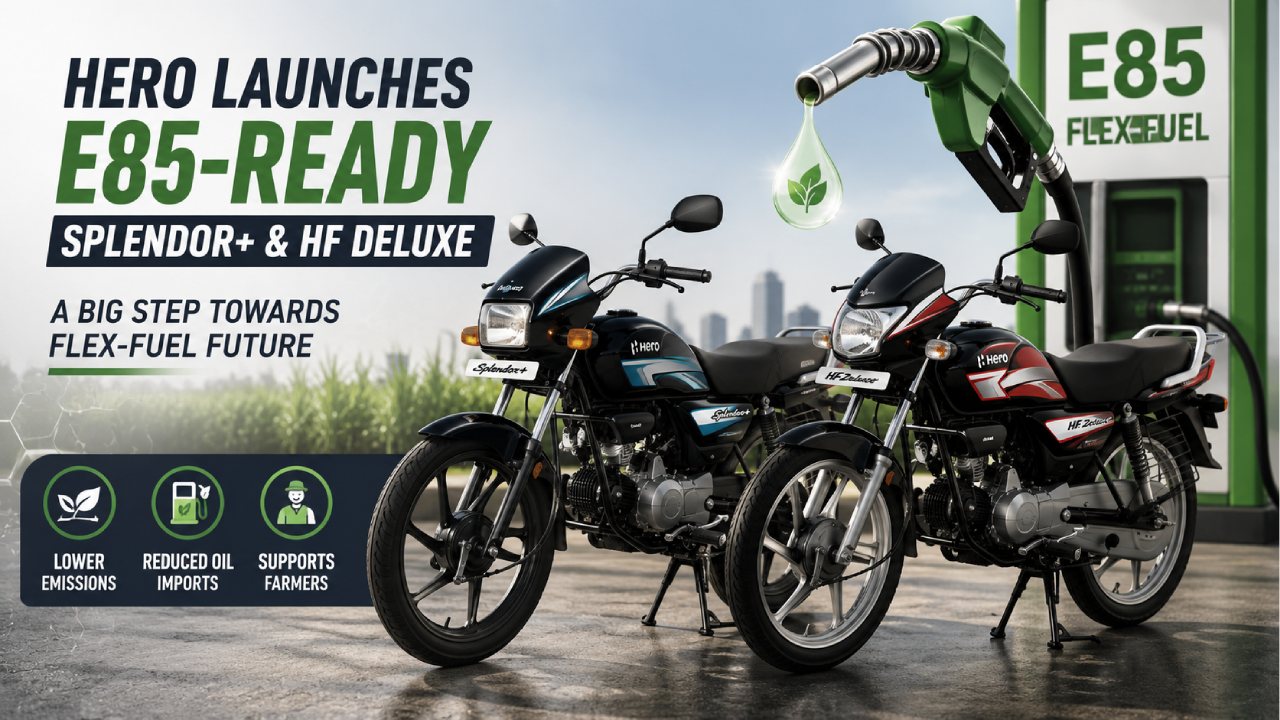
The Indian automobile industry is currently going through a transition period by experimenting with flex-fuel vehicles
Hero has launched the flex-fuel E85-compatible iterations of Splendor+ and HF Deluxe for our market. This represents the popularity of flex-fuel automobiles. As the name suggests, E85 fuel comprises of 85% Ethanol and 15% Petrol. Currently, most petrol stations in the country supply E20 fuel. In fact, cars and motorcycles are being calibrated to run smoothly on fuels carrying Ethanol content upto 20%. Anything beyond that requires specific modifications to the engine components. For now, let us delve deep into the details of this case.
E85-Ready Hero Splendor+ and HF Deluxe Launched
The two-wheeler giant has launched the Splendor+ and HF Deluxe, which can run on upto 85% Ethanol blend in petrol. Hence, users can fill fuel ranging from E20 to E85 and the models are capable of running on these without any struggles. At present, these motorcycles will be available in Delhi and certain parts of Maharashtra from July 2026. Depending on the demand, these will be rolled out across the nation. Note that both these bikes use a 97.2cc single-cylinder mill, which generates a decent 8.6 hp @8,000 RPM and 8.3 Nm @6,000 RPM of peak power and torque, respectively, in the CNG guise. To run on fuels upto E85, the bikes get revised ECU calibration and upgraded fuel system components, including a new fuel pump and secondary fuel filter.
What Does E85 Fuel Entail?
The introduction of E85 fuel in India by the government is a strategic decision. There are many facets associated with this which must be considered before a full-fledged implementation. This includes both advantages and potential challenges with it. The government’s push towards higher ethanol blending is driven by a few clear objectives. First, it helps reduce India’s dependence on imported crude oil, which remains one of the country’s biggest expenses. Second, ethanol is produced from agricultural feedstock such as sugarcane, maize and other crops, creating additional income opportunities for farmers and supporting the rural economy. Finally, ethanol-blended fuels can contribute to lower tailpipe emissions, helping India move towards its environmental goals.
However, increasing the ethanol content beyond E20 is not as straightforward as it may appear. Once ethanol percentages reach levels such as E30, E85 or E100, a host of technical, economic and infrastructural challenges begin to emerge. Vehicles capable of running on such fuels are commonly known as flex-fuel vehicles. While the technology already exists and is being used successfully in countries like Brazil, adopting it on a large scale in India will require careful planning and significant investments. One of the biggest concerns is ethanol’s lower energy density compared to conventional petrol. Simply put, ethanol contains less energy per litre, which means vehicles generally need to burn more fuel to travel the same distance. As a result, fuel efficiency can take a hit, particularly in vehicles that are not specifically designed for high ethanol blends. This could potentially offset some of the cost benefits that consumers expect from alternative fuels.
Vehicle compatibility is another major hurdle. While newer cars are gradually being engineered to handle higher ethanol concentrations, a vast number of vehicles currently on Indian roads were never designed with E85 or E100 in mind. High ethanol content can affect fuel lines, seals, injectors and other engine components over time. This raises concerns about long-term durability, maintenance costs and overall reliability. Even the transition to E20 has required manufacturers to make changes to their vehicles. Moving towards E85 or E100 would demand even more extensive engineering modifications.
Another aspect that often receives less attention is the amount of water required during ethanol production. Since ethanol is largely derived from crops such as sugarcane and maize, producing it on a massive scale inevitably places additional pressure on water resources. This becomes a particularly sensitive issue in a country like India, where several regions already face water scarcity, declining groundwater levels and recurring drought conditions. Balancing energy security with sustainable water usage will be crucial if higher ethanol blends are to become mainstream.
Beyond production, there are logistical challenges as well. Ethanol behaves differently from petrol and is more prone to absorbing moisture and causing corrosion. This means fuel storage facilities, transportation networks, pipelines and dispensing infrastructure may require upgrades to safely handle higher ethanol concentrations. In essence, while E85 and E100 offer attractive benefits in terms of reducing crude oil imports and supporting domestic agriculture, the transition will not be without complications. Before such fuels become commonplace, policymakers, automakers and fuel suppliers will need to address concerns related to vehicle compatibility, infrastructure readiness, fuel efficiency and resource management to ensure a smooth and sustainable rollout.
Editors’ Note
Yatharth Chauhan, Managing Editor
The launch of E85-compatible Hero Splendor+ and HF Deluxe motorcycles marks an important milestone in India’s alternative fuel journey. While the technology promises reduced dependence on crude oil imports and greater support for the agricultural sector, its widespread adoption will depend on fuel availability, infrastructure readiness and long-term reliability. Hero’s decision to introduce flex-fuel motorcycles in the country’s highest-volume commuter segment could encourage other manufacturers to follow suit. However, before E85 becomes mainstream, policymakers and automakers will need to address concerns related to fuel efficiency, vehicle compatibility and sustainable ethanol production
Also Read: Despite 4 Fuel Hikes, Oil Companies Still Losing Rs 600 Crore Per Day