

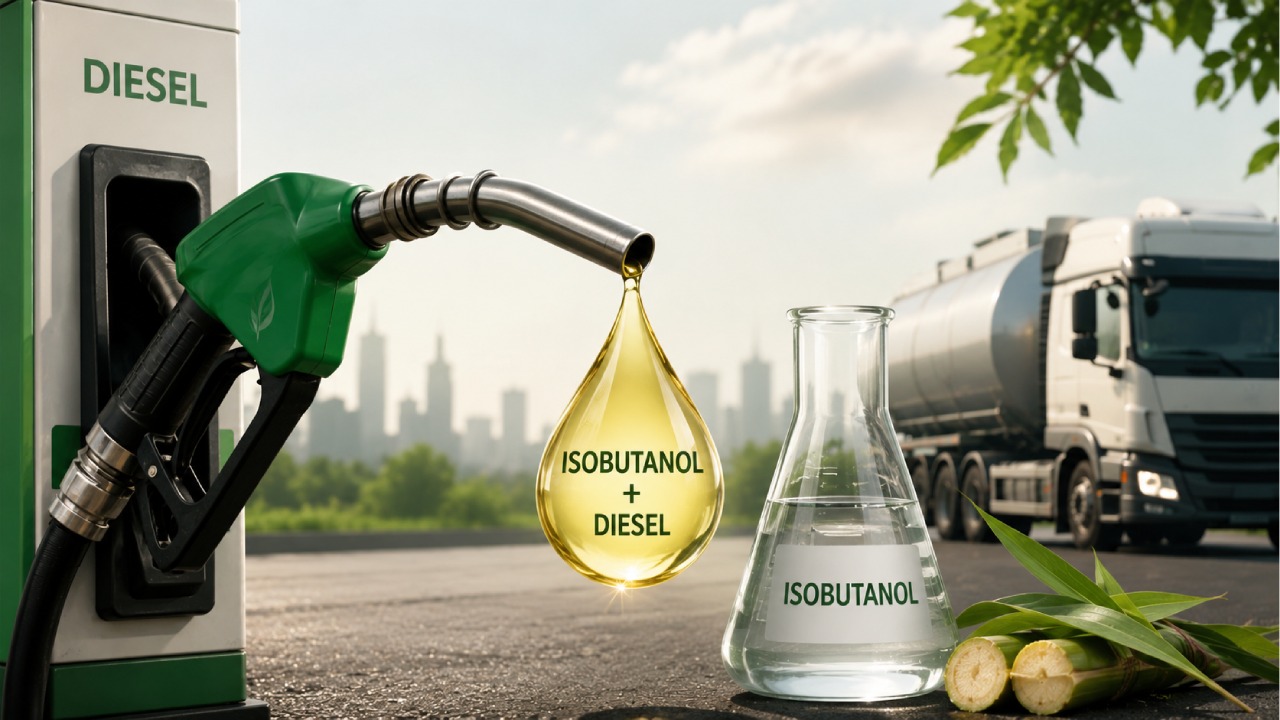
The Indian government is coming up with innovative solutions to take care of its energy and emissions needs
In a rather intriguing turn of events, the Indian government is planning to mandate Isobutanol blending in diesel fuel to cut emissions. This is a huge step in the right direction to frame modern-day solutions to age-old problems. The country is already transitioning from regular petrol to E20 and even higher ethanol-blended fuel for various advantages. Now, the government wishes to address the commercial and private diesel-powered industry. Note that the diesel consumption in India is twice that of petrol. Therefore, any measure to tackle emissions from diesel mills will have far more widespread impact than working on petrol vehicles.
What is Isobutanol-Diesel Blending?
For the uninitiated, Isobutanol-diesel blending refers to mixing a small percentage of Isobutanol, a biofuel alcohol produced from renewable sources like corn, sugarcane and agricultural waste, with conventional diesel fuel. The aim is to reduce dependence on fossil fuels and lower harmful emissions from vehicles. Compared to ethanol, Isobutanol has a higher energy content and mixes more easily with diesel, making it a promising alternative fuel. It can improve combustion efficiency and reduce smoke and particulate emissions. However, extensive testing is still required to ensure long-term compatibility with modern diesel engines and fuel systems.
How Will It Impact Us?
Now, India is a rapidly growing economy. Among many factors, the capability of a nation to make its transport network as efficient as possible is a key factor in expanding GDP. That is something the developed nations have focused on a lot. There are dedicated demarcations between slow and fast-moving traffic lanes to ensure that the average speed of automobiles remains high. As a consequence, commercial vehicles like trucks and trailers are able to deliver goods from one part of the country to another at a fast pace. That is exactly what India wants to achieve going forward with things like Multi-Lane Free Flow (MLFF) barrier-less tolling system. It has already been implemented at 2 toll plazas and is planned to expand to all four-lane-plus toll plazas in the country within the forthcoming year.
However, a bigger question is to make the commercial vehicles more efficient in addition to improving the transportation infrastructure. That is where aspects like Isobutanol-blended diesel, electric trucks and hydrogen fuel come into the picture. These may sound ambitious to implement in a large country like India, but that is the only way to make a significant impact to cut our emission needs and dependency on crude oil imports and global trade routes. Therefore, India can become in charge of its own energy needs to some extent and get saved from the adverse effects of things like the ongoing US-Israel and Iran war.
Speaking at a CII Summit on Friday, V. Umashankar, Secretary at the Ministry of Road Transport and Highways, announced that the diesel blending process is expected to be rolled out later this year. He remarked, “Bharat Petroleum is already undertaking strategic research for isobutanol blending with diesel. And the results are very encouraging. It is quite likely that the blending mandate will start coming in somewhere later this year. And diesel consumption is almost two times that of petrol consumption. So, blending diesel will have a far greater impact on our energy security than blending petrol.”
Apart from that, the ministry has also commissioned the Automotive Research Association of India (ARAI) to study flex-fuel engines, which can run on up to 100% Isobutanol as an alternative fuel to diesel. That could be a game-changer in this industry. A key observation from the initial tests was that the Isobutanol blending substantially reduces pollution from diesel vehicles without altering their running. Furthermore, using this blended diesel doesn’t even require any major changes to a vehicle’s engine or exhaust system.
The Secretary also said that the ministry will soon release a draft notification for truck trailers. This is a great step to create and support a new ecosystem for heavy-duty electric trucks. The prime aim of this policy will be to address the infrastructure needed for battery swapping and charging. Interestingly, the authorities are exploring the possibility of “tractor-trailer interchangeability”, where the entire front of the truck would be detached and replaced with a fully charged unit, while the trailer remains in use, while the power source is swapped out at specific locations. This is a creative method to bypass the long charging times inherently associated with electric vehicles.
The government has also been experimenting with hydrogen fuel and the results have been “very good.” The Secretary said, “The results are very good. The key cost is comparable with respect to other forms of logistics travel. It’s not high. The only high-cost element there is the hydrogen refuelling stations. And presently in the pilot projects, government support is being provided.” Also, hydrogen-powered public buses were recently launched on routes connecting Delhi with Faridabad and Noida. All in all, the entire commercial vehicle industry is being transformed to suit the current times.
Editor’s Note
Yatharth Chauhan, Managing Editor
I have always maintained that India’s energy strategy cannot rely on a single solution, and the proposed Isobutanol-diesel blending policy is another example of the government exploring multiple pathways simultaneously. Considering that diesel consumption in India is nearly twice that of petrol, even a modest reduction in emissions and crude oil dependence could have a meaningful impact at a national scale. However, as we have seen with ethanol blending, the real challenge lies not in announcing ambitious targets but in ensuring long-term compatibility, infrastructure readiness and economic viability. If implemented correctly, Isobutanol could emerge as an important bridge technology while the commercial vehicle industry gradually transitions towards electric and hydrogen-powered mobility.
Also Read: How Gadkari’s E85 and E100 Rollout Can Be A Nightmare