

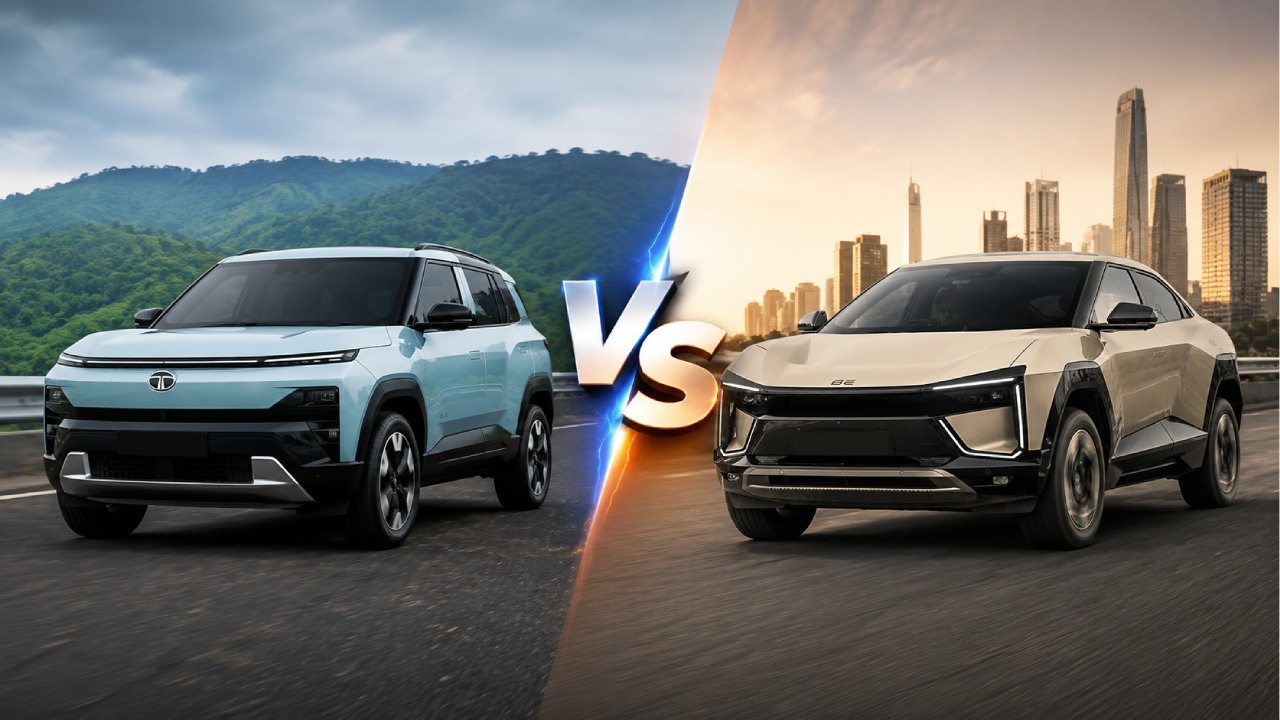
The electric SUV segment in India is growing rapidly, particularly the segment around Rs 20 lakh
In this post, we compare the newly launched Tata Sierra EV and the Mahindra BE 6 on the basis of specs, price, features, etc. Note that the indigenous carmakers have been launching EVs left, right and centre. In fact, Tata Motors continues to be the segment leader in the EV space. Mahindra is surely catching up with some pretty bold and impressive products. Hence, it becomes incredibly exciting for the customers since they have multiple options to choose the right EV for their individual requirements. For now, let us delve deep into the details of this thorough comparison here.
Tata Sierra EV vs Mahindra BE 6 – Price Comparison
Let us start with what is perhaps the most critical aspect of car buying in India, the price. The new Tata Sierra EV in India ranges between Rs 18.79 lakh and Rs 24.79 lakh, ex-showroom. Note that the 7.2 kWh AC fast charger installation costs Rs 49,000 extra, while opting for the QWD (all-wheel-drive) will set you back by Rs 1.2 lakh. On the other hand, the Mahindra BE 6 starts at Rs 18.90 lakh and goes up to Rs 28.49 lakh, ex-showroom. Even these prices exclude the 7.2 kW AC charger installation cost of Rs 50,000. Remember, this is Rs 75,000 for an 11.2 kW AC charger. Hence, the Sierra EV certainly has an edge in this regard, especially towards the higher end. The variant-wise prices are:
| Price (ex-sh.) | Tata Sierra EV 63 kWh | Tata Sierra EV 75 kWh |
| Pure | Rs 18.79 lakh | – |
| Pure S | Rs 19.99 lakh | – |
| Adventure | Rs 20.99 lakh | Rs 22.19 lakh |
| Empowered | Rs 22.79 lakh | Rs 23.79 lakh |
| Empowered A | – | Rs 24.79 lakh |
| Price (ex-sh.) | Mahindra BE 6 |
| Pack One 59 kWh | Rs 18.90 lakh |
| Pack Two 59 kWh | Rs 21.90 lakh |
| Pack One Above 59 kWh | Rs 20.50 lakh |
| Pack Three Select 59 kWh | Rs 24.50 lakh |
| Pack Two 79 kWh | Rs 23.50 lakh |
| Pack Three 79 kWh | Rs 26.90 lakh |
Tata Sierra EV vs Mahindra BE 6 – Features and Safety Comparison
This is one area which has become immensely pertinent for a whole bunch of car buyers in India in recent times. Thankfully, both Tata and Mahindra equip their products with all the bells and whistles in terms of technology, active and safety features, creature comforts and connectivity. That puts them on equal footing. Some of the main traits of the new Tata Sierra EV are:
- Triple Screen Setup – Driver’s Instrument Cluster, Infotainment Display and Passenger Display
- Arcade.ev Ecosystem
- AirConsole (in-car gaming using smartphones)
- Segment-largest Panoramic Sunroof
- 12-speaker JBL Black Premium Audio System with Dolby Atmos and SonicShaft
- HypAR Head-up Display with 19 Augmented Visuals and Multiple Modes
- e-Valet Suite with Auto Park, Summon and Reverse Assist
- Digi Access for Seamless Entry and Control
- 540°HD Camera with 4Sight Blind Spot View and Transparent Mode
- 622-litre Boot Space
- Powered Gesture Tailgate
- Powered Seats with Thigh Support Extender
- OTA Updates via T.iDAL 2.0 Architecture
- DrivePay (in-car UPI, commerce + charging payments)
- Intelligent EV Route Planner for Android Auto
- Vehicle-to-Load (V2L) + Vehicle-to-Vehicle (V2V) Capability
- iRA.ev Connected Ecosystem (70+ features, 5G enabled)
- Level 2+ ADAS with 22 Features
- Adaptive Front & Rear Turn Cameras for Enhanced Visibility
Similarly, even the Mahindra BE 6 is among the most feature-laden models in this space. Its top highlights include:
- MAIA (Mahindra Artificial Intelligence Architecture) with Advanced Neural Engine
- Dual 12.3-inch Floating Screens for Instrument Cluster and Infotainment
- WiFi 6.0, 24 GB RAM, 128 GB Storage
- Qualcomm Snapdragon 8295
- 16-speaker Harmon Kardon Sound System with Dolby Atmos
- 5G Internet Connectivity
- Massive Panoramic Sunroof with Integrated Multi-Colour Lighting Patterns
- Auto Park Assist with 12 Ultrasonic Sensors
- In-car Camera
- Electronic Parking Brake
- Ambient Lighting
- Powered Driver’s Seat with Memory Function
- OTA Updates
- Level 2 ADAS Suite with 5 Radars and 1 Vision Camera
- 360-degree Cameras
- 7 Airbags
- Electric Power Steering with Variable Gear Ratios
- Augmented-Reality (AR) Heads Up Display (HUD)
- Driver and Occupant Monitoring System (DOMS)
- Signature Sonic Tunes Curated by AR Rahman
Tata Sierra EV vs Mahindra BE 6 – Specs Comparison
Let us now discuss what powers these potent EVs. The Tata Sierra EV is offered with two battery pack options – 63 kWh and 75 kWh, both featuring liquid-cooled and IP67-rated construction for enhanced durability and thermal management. The 63 kWh version develops 238 PS and 315 Nm of torque, while the larger 75 kWh battery is available in two configurations – a single-motor setup producing 209 PS and 315 Nm, and a dual-motor Quad Wheel Drive (QWD) version delivering an impressive 306 PS and 504 Nm. Tata claims a C75 real-world driving range of 440-460 km for the smaller battery and 510-530 km for the larger pack, while the QWD variant is expected to return around 480-500 km on a single charge. Such figures should provide ample confidence for buyers planning frequent long-distance journeys.
On the charging front, Tata Motors claims that high-capacity DC fast chargers (above 110 kW/261 A for the 63 kWh battery and above 120 kW/330 A for the 75 kWh unit) can replenish the battery from 20% to 80% in just 26 minutes. Using a 7.2 kW AC charger, a full 10-100% charge takes approximately 8.9 hours for the 63 kWh variant and 10.5 hours for the 75 kWh version. Performance is equally impressive, with the range-topping model capable of sprinting from 0-100 km/h in just 5.8 seconds in Boost mode. Enhancing overall ride comfort is Tata’s Ultra Glide suspension equipped with Frequency Dependent Damping, which promises a plush ride over rough surfaces while maintaining composure and stability at higher speeds.
In comparison, the Mahindra BE 6 is also available with two battery pack choices – 59 kWh and 79 kWh. Underpinned by Mahindra’s dedicated INGLO architecture, the electric SUV employs BYD’s advanced Blade Cell battery technology featuring LFP chemistry. The smaller battery variant produces 228 hp and 380 Nm of torque, while the larger pack boosts output to 281 hp with the same 380 Nm torque figure. Mahindra claims an impressive range of 535 km for the 59 kWh version and up to 682 km (550 km WLTP) for the 79 kWh model. Charging capabilities are equally noteworthy, with a 175 kW DC fast charger capable of taking the larger battery from 20% to 80% in just 20 minutes. Drivers can choose between Range, Everyday and Race drive modes, with the latter unlocking maximum performance and enabling a brisk 0-100 km/h run in just 6.7 seconds. Note that while most parameters are comparable, the Sierra EV is the only one with the option of an all-wheel-drive configuration.
| Specs | Tata Sierra EV | Mahindra BE 6 |
| Battery | 63 kWh / 75 kWh | 59 kWh / 79 kWh |
| Range | 440-460 km / 510-530 km (C75 Real-world) | 535 km / 682 km |
| Power | 209 PS / 306 PS | 231 PS / 285 PS |
| Torque | 315 Nm / 504 Nm | 380 Nm |
| Acc. (0-100 km/l) | 5.8 seconds | 6.7 seconds |
| Charging (20-80%) | 26 mins (w/ 120 kW charger) | 20 mins (20%-80% w/ 175 kW) |
| Drivetrain | RWD / QWD | RWD |
My View
Now, choosing between these two compelling Indian electric EVs might be a challenge. Nevertheless, there are distinct pros and cons to each of these. If you are in the market for an imposing electric SUV with tons of new-age amenities, off-roading capabilities and want to save some bucks, the Tata Sierra EV makes better sense. However, if you want something that looks straight out of a sci-fi movie set, want all the bells and whistles but can do without the all-wheel-drive setup, the Mahindra BE 6 should be your pick. In any case, I would recommend our readers to experience the two in the flesh by visiting your nearest dealerships. That will help you make an informed decision. Also, it is hard to go wrong with any of these.
Editor’s Note
Yatharth Chauhan, Managing Editor
The arrival of the Tata Sierra EV is yet another sign of how rapidly the electric SUV segment around the Rs 20 lakh mark is evolving in India. What makes this comparison particularly interesting is that it pits two homegrown manufacturers against each other, both of whom are pushing the boundaries of EV technology, features and performance. While Tata Motors continues to enjoy a strong foothold in the electric passenger vehicle space, Mahindra has emerged as a serious challenger with its new-generation INGLO-based products. On paper, both the Sierra EV and BE 6 bring compelling strengths to the table, making the final choice far from straightforward. Ultimately, this is great news for buyers, who now have access to two highly capable electric SUVs tailored to different priorities and driving preferences.
Also Read: New Tata Sierra EV Review – What We Like and What We Don’t