

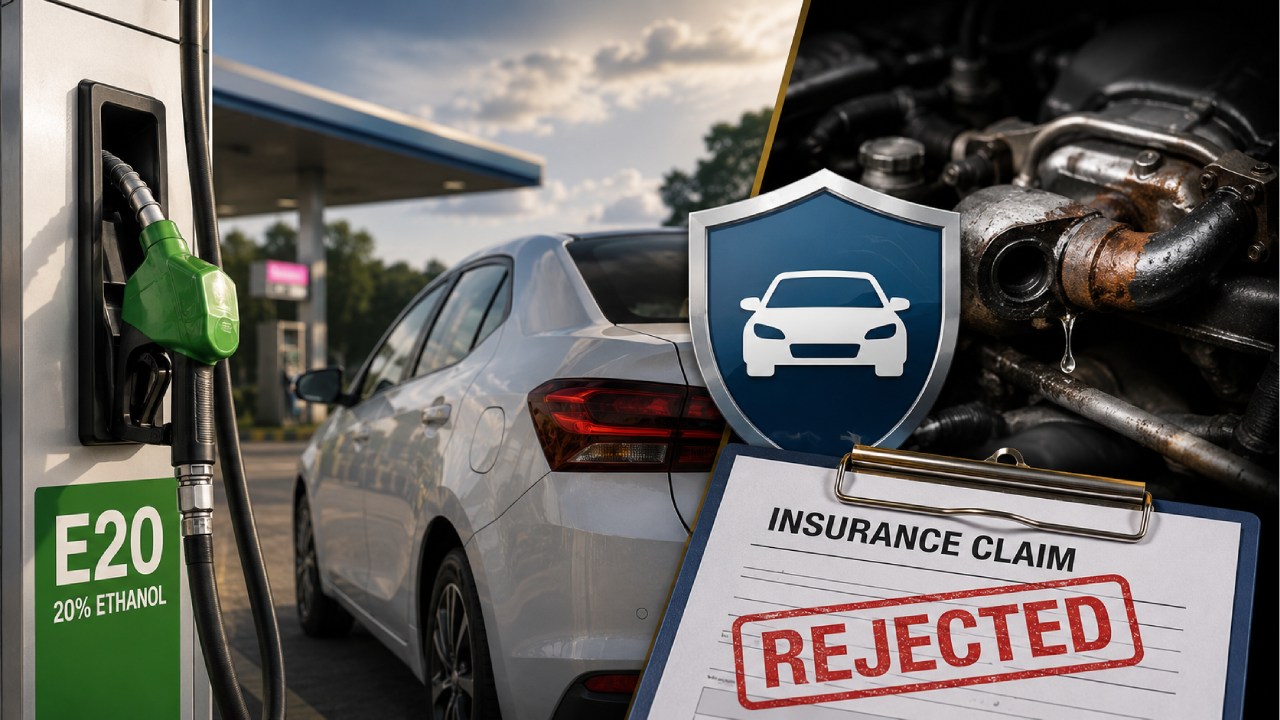
The Indian automobile industry has been having an interesting time with the government’s key focus on flex fuel cars
Updated on 16.06.2026 – Amidst a slurry of confusion around whether or not an insurance company will cover the damage expenses arising from the use of E20 fuel on old cars, a fresh statement has been issued by ICICI Lombard. They said, “ICICI Lombard General Insurance reaffirms that motor insurance policies remain fully valid by the use of E-20 fuel. We further clarify that we do not treat usage of E-20 fuel in older vehicles as a negligence and we consider E-20 fuel program as a progressive environment friendly step. Our insurance policies are designed to cover accidental damages, theft, personal accident for owner-drivers and co-passengers, as well as third-party liabilities, depending on the covers opted by the insured. Claims are admissible based on the occurrence of insured perils such as vehicle accidents or theft. The type of fuel used in the vehicle such as Petrol, Diesel, CNG & so on is not a determining factor in claim admissibility. Accordingly, if a claim is admissible with conventional fuel, it is equally admissible with E-20 fuel and ICICI Lombard does not reject claims merely on the basis of fuel usage.
Now, this statement was released after a blog post published on June 9, 2026, where ICICI Lombard mentioned that insurance claims arising from damage caused by E20 fuel could face scrutiny if the vehicle was not designed to run on the higher-ethanol petrol blend. Interestingly, the newer statement clearly indicates that it is willing to cover the damage on cars even if the customers decide to use E20 fuel. It won’t be considered negligence. Furthermore, it clarifies that the company won’t reject any claims just because of the kind of fuel used. This should bring relief to the car owners who got entangled in this entire situation and doubts hovering around claims.
Having said that, the company’s initial statement reads, “standard policies exclude consequential damage, which is damage that builds up over time rather than happening in a single incident, like an accident”. Now the problem is that the damage of using E20 fuel on a vehicle not designed for it will have “consequential damage” over time. For instance, the increased ethanol content in fuel can attract more moisture, which can, in turn, corrode fuel system components like gaskets, seals, lines, tanks, etc. In fact, buying the add-on covers won’t help either because ICICI says that “engine protection add-ons offer some coverage, but most are designed for water ingress or oil leakage, not chemical corrosion from fuel”. Hence, the new announcement might offer some relief, but car owners must be careful themselves to ensure that they don’t end up in this position in the first place.
ICICI Lombard Says E20 Fuel Use in Older Cars Can Be Treated As ‘Improper Use’ or ‘Negligence’
Originally published on 15.06.2026 – India’s largest private general insurance company, ICICI Lombard, has recently said that the car insurers may reject the E20 fuel damage claims in older, non-compatible cars sold before April 2023. Now, this is a concerning issue for a whole bunch of car owners. We know that the last couple of years have seen the introduction and wide-scale implementation and availability of E20 fuel in India. I am sure that you would already know that E20 represents 20% Ethanol blending with regular petrol. Today, the discussion has been to bring in ethanol blends up to 100% (E100) in the coming years. The reason is quite simple – reduce crude oil imports. Well, there are other aspects to it as well. For now, let us delve into the details of what kind of insurance issues one might face.
ICICI Lombard Says E20 Fuel Use in Older Cars Can Be Treated As ‘Improper Use’ or ‘Negligence’
According to the latest statement released by ICICI Lombard, if the car owners file for an insurance claim for damaged components due to the use of E20 fuel on cars which are not E20 compatible, they might face denial. This is pertinent because millions of cars are not compatible with ethanol blends of up to 20%. In fact, when the government decided to sell only E20 fuel at petrol stations across the nation, there was nationwide backlash and protests. Hence, the government had to take back the decision to force E20 fuel on the users. As a consequence, the car owners today have the option of choosing regular fuel vs E20 fuel at every petrol pump.
The main features of ethanol blending are the reduction of crude oil imports, a boost to the local farmers’ economy due to the increased use of crops like sugarcane, rice, maize, etc., which are used for the production of ethanol and slightly lower tailpipe emissions. However, there are a few negative aspects to this as well. This includes things like an increased risk of corrosion, lower mileage and paying the same price per litre for E20 fuel as regular petrol even though it contains 20% less petrol.
Now, as the country is slowly adapting to E20 fuels and cars manufactured after 2023 are all E20 compatible, the government is bringing new policies to introduce fuels up to 100%. These are denoted by E30, E85 and E100 monikers. As one would imagine, the cars will have to be re-engineered to ensure that they can run on such a wide petrol-ethanol mix. However, the current problem lies in the fact that what can consumers do if they face challenges and problems in their cars after using E20 fuel?
We must understand that if a car is driven on a fuel which is not compatible, the engine and other car components might get affected. What is even more crucial to know is the fact that one might not experience the issues right away. Instead, the problems in cars may appear after long-term usage. For instance, some non-E2-compatible car owners are reporting things like increased corrosion and fluid leakages in their vehicles. The damage stemming from that is being sent to the insurance companies for claims. However, companies like ICICI Lombard are coming up with statements like “using a fuel your vehicle was not made for can be treated as improper use or negligence. Insurers may review these claims from that angle, and rejection is possible”.
This can become a grave concern as the number of car owners with such complaints increases. We know that the use of E20 fuel can show its true effects on non-E20 vehicles after years of running. Therefore, it is likely that more such cases will crop up in the coming years on cars that have been sold prior to 2023. Hence, the car owners must read the user’s manual thoroughly and understand what fuel their cars are compatible with. If they know that the vehicle is not designed to run on anything beyond 5% ethanol, for instance, then they must not get E20 fuel at the petrol pumps. That is a proactive measure to keep your vehicle healthy and running for a long time.
Editor’s Note
Yatharth Chauhan, Managing Editor
India’s transition towards higher ethanol-blended fuels is entering a critical phase, and this latest development highlights a challenge that many vehicle owners may not have considered. While E20 fuel is being promoted as a step towards reducing crude oil imports and improving energy security, compatibility remains a major concern for millions of older vehicles on Indian roads. ICICI Lombard’s stance serves as an important reminder that using a fuel not approved by the manufacturer could have consequences beyond vehicle reliability, potentially extending to insurance claims as well. As policymakers continue to push for higher ethanol blends and flex-fuel technologies, consumers must stay informed about what their vehicles are designed to handle. Ultimately, reading the owner’s manual and choosing the correct fuel today could save owners from expensive repairs and claim disputes in the future
Also Read: India Exempts Excise Duty on Ethanol-Blended Petrol But There’s A Catch