

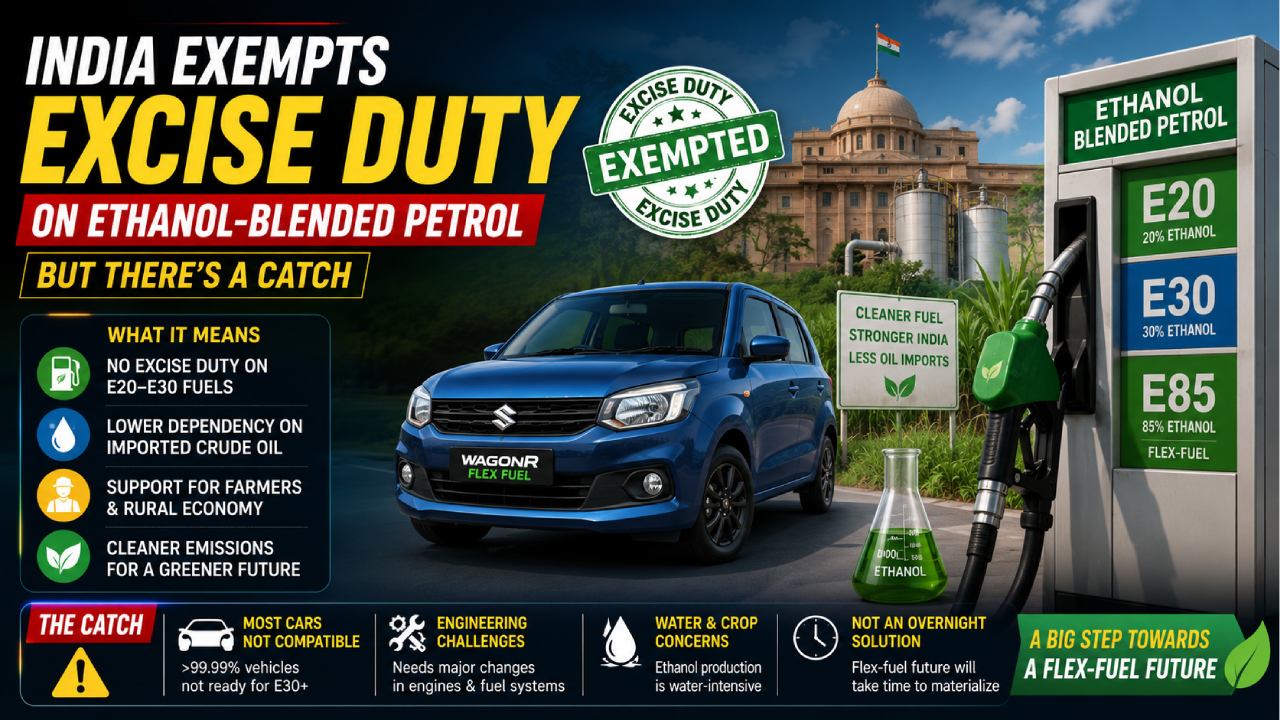
There are rapid developments in fuel technology and policies at the moment in India, as petrol and diesel prices shoot up
In a bid to plan for the next phase of ethanol-blended petrol beyond E20, the government has announced the exemption of excise duty on E20-E30 fuels. For the uninitiated, this represents petrol with 22% and 30% ethanol blends, respectively. In times where E20 has barely become the norm, the government is already thinking of introducing petrol with over 20% ethanol mix, which can even go up to 85% (denoted by E85). The latter are classified under the flex-fuel tag. Clearly, the focus is on reducing crude oil imports amidst the global energy crisis due to the ongoing US and Israel conflict with Iran.
India Exempts Excise Duty on Ethanol-Blended Petrol
As we know, even the E20 fuel needs certain changes to the vehicle to remain compliant for a hassle-free operation; going beyond this would need a major overhaul in terms of engineering. In fact, there aren’t all that many cars on sale currently which can support such high ethanol blends. The recently showcased Maruti Wagon R flex fuel remains the only passenger car which is capable of running on fuels ranging from E20 to E100. However, the reality is that more than 99.99% of vehicles are not compatible with such high ethanol blends.
As a consequence, the actual benefit for the end customers at the moment is limited. Hence, the government might want to make flex-fuel cars widely accessible to a whole lot of consumers, but it will take a lot of time for it to become the norm. There are challenges on multiple levels. These include the water-intensive production of crops which are needed to produce huge volumes of ethanol and re-engineered vehicles that can run on a wide ratio of ethanol-petrol mix. Hence, we can’t expect a nationwide adoption of the fuels beyond E20 overnight.
Nevertheless, the recent announcements clearly indicate that the government wishes to push this narrative as the petrol prices in the country increase. The ongoing global challenges are causing volatility in fuel prices not just in India but in many parts of the world. Therefore, our government wants to manage the dependency on international markets for its energy needs. To what extent we will be able to achieve this in the coming years remains to be seen.
Is It Feasible?
The government’s decision to exempt excise duty on petrol containing 22% to 30% ethanol is a clear indication of where India’s fuel policy is headed. While the country has only recently completed the transition towards E20 fuel, policymakers are already laying the groundwork for higher ethanol blends and eventually a flex-fuel ecosystem. On paper, the objectives are understandable. Reducing crude oil imports, improving energy security and supporting the agricultural sector are all worthy goals, particularly at a time when global geopolitical tensions continue to keep fuel prices under pressure.
However, the practical challenges associated with higher ethanol blends cannot be ignored. The reality is that almost every petrol vehicle currently on Indian roads is engineered for conventional fuel or, at best, E20 compatibility. Moving towards E30, E85 or even E100 would require substantial modifications to fuel systems, engine components and calibration strategies. This is not a transition that can happen overnight. In fact, only a handful of flex-fuel vehicles have been showcased in India so far, highlighting how early we still are in this journey.
Another aspect that deserves attention is the large-scale production of ethanol itself. While ethanol offers benefits in terms of reducing fossil fuel dependence, producing it in massive quantities requires significant agricultural resources and considerable amounts of water. This is particularly relevant for a country where groundwater depletion and irrigation challenges are already major concerns in several regions.
Ultimately, the excise duty exemption should be viewed as a long-term policy signal rather than an immediate benefit for consumers. It demonstrates the government’s intent to accelerate the adoption of alternative fuels, but the supporting ecosystem, from vehicle technology and infrastructure to sustainable ethanol production, will need years of development before higher ethanol blends become a mainstream reality in India.
Editor’s Note
Yatharth Chauhan, Managing Editor
The excise duty exemption on higher ethanol-blended petrol is an important policy signal, but its real impact will be felt years down the line rather than immediately. While reducing crude oil imports and improving energy security are sensible objectives, the reality is that the vast majority of vehicles on Indian roads today are not designed to run on fuels beyond E20. Moreover, large-scale ethanol production brings its own challenges, particularly in terms of water consumption and agricultural resources. Therefore, while the government’s intent is clear, the transition towards E30, E85 or flex-fuel mobility will require substantial investments in vehicle technology, infrastructure and sustainable fuel production before it can become a mainstream reality.
Also Read: Maruti Fronx Hybrid Spotted Testing – Expected Mileage 30 km/l