

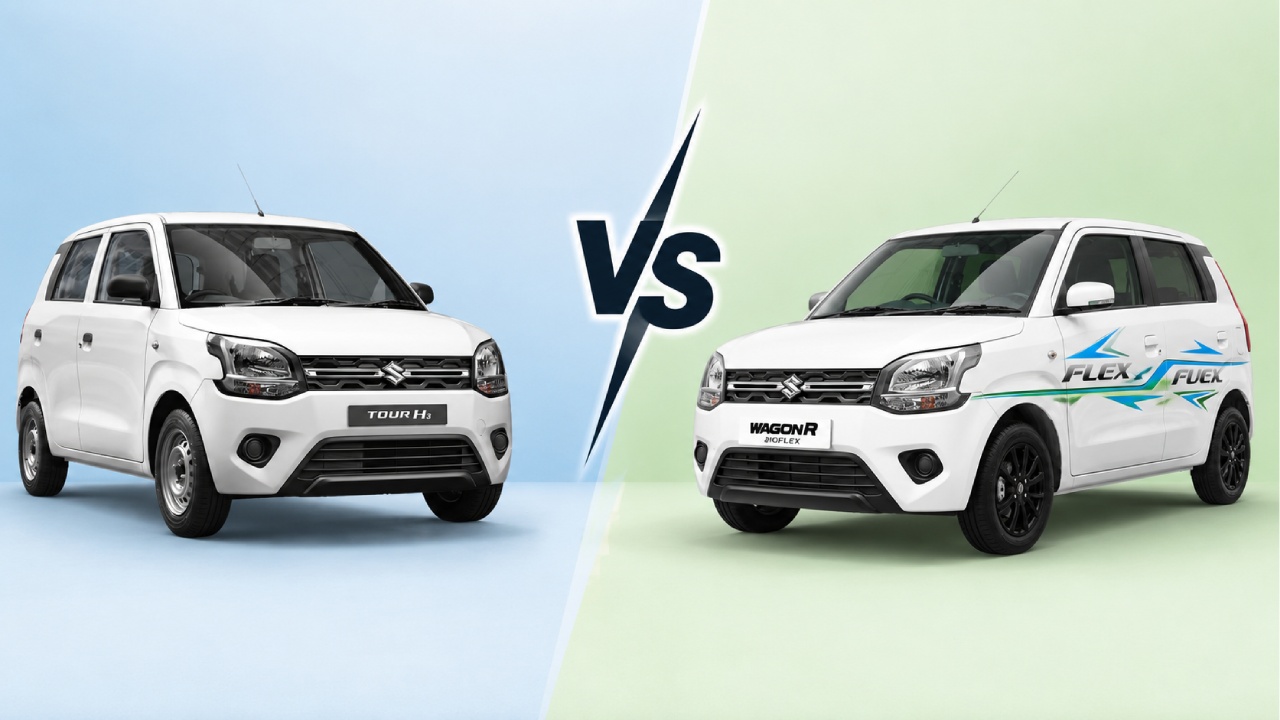
The new iteration of the Wagon R can run on an ethanol blend of up to 100%
In this post, we compare the new Maruti Wagon R Flex-fuel (called the Wagon R Bioflex) with the Tour H3 version. Note that this is due to the fact that the flex-fuel-powered Wagon R is currently exclusively for commercial operations and not private buyers. Similarly, the Tour H3 is the taxi iteration of the Wagon R. In essence, it makes sense to compare the performance, mileage and running costs of these two avatars of the prominent hatchback. Let us delve deep into this post.
Maruti Wagon R Flex-Fuel vs Wagon R Tour H3 – Price Comparison
In a price-conscious market like India, the cost of a car plays a crucial role. The new Maruti Wagon R Flex-Fuel is based on the ZXi+ trim and retails for Rs 7.24 lakh, ex-showroom. This is Rs 86,000 more expensive than the corresponding petrol trim of the regular range. On the other hand, the Wagon R Tour H3 ranges from Rs 4.99 lakh to Rs 5.89 lakh, ex-showroom. Hence, there is a difference of around Rs 1.35 lakh to Rs 2.25 lakh, ex-showroom.
| Price (ex-sh.) | Wagon R Flex-Fuel | Wagon R Tour H3 |
| Base Model | Rs 7.24 lakh | Rs 4.99 lakh |
| Top Model | Rs 7.24 lakh | Rs 5.89 lakh |
Maruti Wagon R Flex-Fuel vs Wagon R Tour H3 – Specs Comparison
The new Maruti Wagon R Flex-Fuel carries a 1.2-litre 4-cylinder naturally aspirated K12N engine, which generates a decent 91 hp and 114 Nm of peak power and torque, respectively. It comes mated to a sole 5-speed manual transmission. To ensure smooth operation across a wide range of ethanol blends (20% to 100%), it gets updated fuel injectors, fuel pumps, fuel lines, a recalibrated ECU and an ethanol sensor. On the other hand, the Tour H3 version of the Wagon R uses a 1.0-litre naturally aspirated 3-cylinder petrol mill good for a slightly lower 69 hp and 89 Nm of peak power and torque, respectively. The transmission option remains the same.
| Specs | Wagon R Flex-Fuel | Wagon R Tour H3 |
| Engine | 1.2L 4-cyl Flex-Fuel | 1.0L 3-cyl Petrol |
| Power | 91 hp | 69 hp |
| Torque | 114 Nm | 89 Nm |
| Transmission | 5MT | 5MT |
Maruti Wagon R Flex-Fuel vs Wagon R Tour H3
Now, the exterior and interior styling bears little difference between the two apart from a few badges on the body. However, the main aspect is the running cost since these cars are designed for commercial use. This means that the running will be high. The claimed mileage figures for the Tour H3 are 25.22 km/l for the petrol and 34.41 km/kg for the CNG version. Unfortunately, the exact mileage number for the Bioflex iteration is not out yet. Still, the main aspect is that the higher ethanol blended petrol is around Rs 20 per litre cheaper than the regular petrol.
Note that this entire amount can’t be considered as a saving because the lower petrol content also means lower mileage because ethanol is less energy dense than petrol. Therefore, to produce the same amount of performance, more fuel will be required. Now, it remains to be seen whether, over a long period of operation, this price difference can offset the initial premium customers will need to pay for the flex-fuel car. In any case, that is what the buyers will have to calculate before making the final purchase decision.
Editor’s Note
Yatharth Chauhan, Managing Editor
The arrival of the Wagon R Flex-Fuel marks an important step in India’s push towards alternative fuels and reduced dependence on imported crude oil. However, for commercial buyers, the decision is not as straightforward as choosing the newest technology. While the flex-fuel model promises lower fuel costs through higher ethanol blends, its higher purchase price and potential impact on fuel efficiency will require careful cost calculations. On the other hand, the Wagon R Tour H3 continues to be a proven and affordable option, particularly in its CNG guise. Ultimately, the real winner will depend on how ethanol pricing, fuel availability and long-term running costs evolve over the coming years.
Also Read: New Maruti Wagon R Flex-Fuel vs Tata Tiago iCNG – Which One To Buy?