

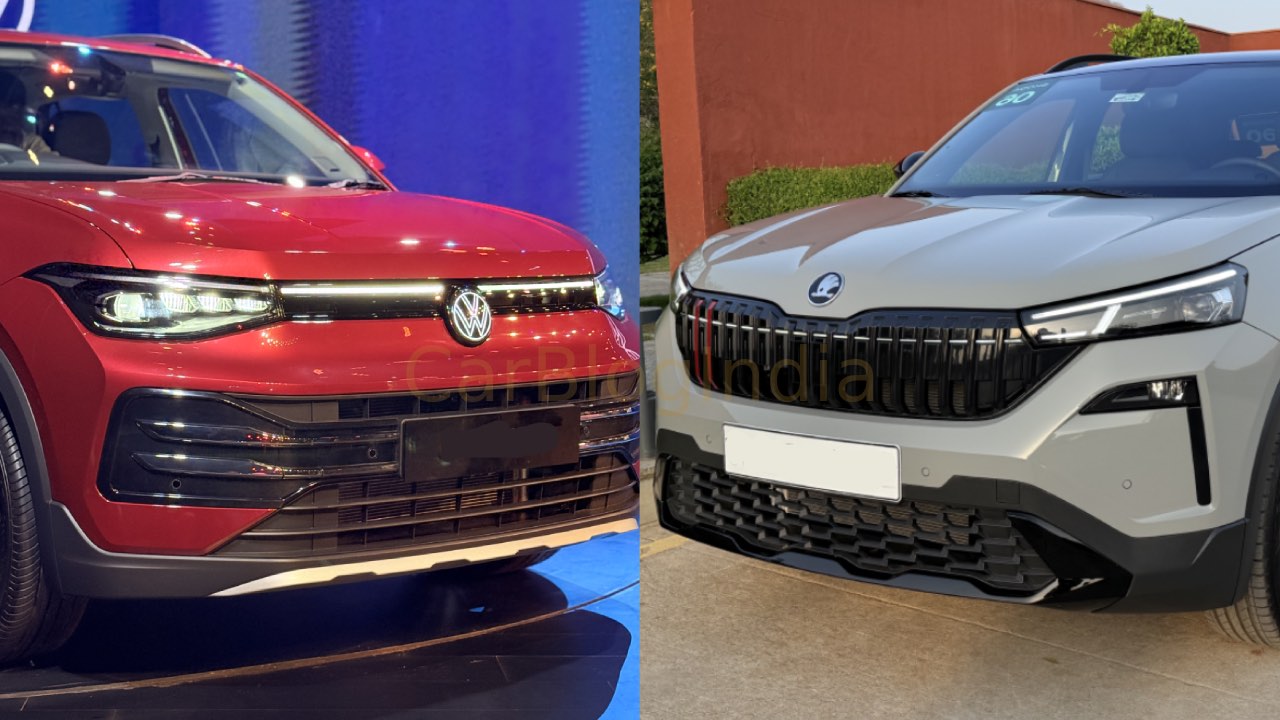
Volkswagen has finally launched the facelifted Taigun, and as expected, it arrives with meaningful updates across design, features, and powertrain efficiency. This puts it head-to-head with its sibling, the Skoda Kushaq facelift, a car that already had an equally strong footing in the SUV space, but recently got a similar set of updates. While both models share the same MQB-A0-IN platform, the latest round of updates has created some more differences. Let’s break it down for you:
What’s New on the VW Taigun Facelift
The Taigun facelift doesn’t attempt a radical redesign, but the changes are noticeable enough. Up front, you get sleeker LED lighting elements, a revised grille, and a more modern stance. The rear now features a connected light bar, which instantly gives it a more premium look. Inside, Volkswagen has clearly focused on improving perceived quality and tech. The cabin now gets:
- 10.25-inch digital instrument cluster
- 10.1-inch touchscreen infotainment
- Powered and Ventilated front seats
- Wireless charging
- Panoramic Sunroof
- Automatic headlamps
- AI-based voice assistant
On the mechanical side, the big highlight is the introduction of a new 8-speed automatic gearbox with the 1.0-litre TSI engine, which improves efficiency by up to 6 percent. Safety remains a strong point, with six airbags and electronic stability control offered as standard.
Skoda Kushaq Facelift: What It Brings
The Skoda Kushaq facelift follows a slightly different. The design tweaks are subtle, focusing on refreshed styling elements, but the equipment list gets a bigger update. It continues with multiple variants including Classic Plus, Signature, Sportline, Prestige, and Monte Carlo, and all of these now come with an sunroof. Where the Kushaq scores a tad higher is in offering a strong base package. Even the entry-level variant packs in features like:
- Sunroof
- Alloy wheels
- Rain-sensing wipers
- Auto headlights
Mechanically, it continues with the same 1.0-litre and 1.5-litre TSI engines, with the former getting the new 8-speed automatic gearbox in interest of higher economy and smoothness.
Performance & Efficiency Comparison
Under the skin, both SUVs are nearly identical, but Volkswagen has managed to extract slightly better efficiency figures with the facelift. The Taigun facelift delivers marginally higher mileage across all engine options:
- 1.0 TSI MT: 19.98 kmpl vs 19.66 kmpl
- 1.0 TSI AT: 19.54 kmpl vs 19.09 kmpl
- 1.5 TSI DSG: 18.85 kmpl vs 18.72 kmpl
VW Taigun vs Skoda Kushaq facelift: Price Comparison
| Model | Price Range (Ex-showroom) |
|---|---|
| Volkswagen Taigun Facelift | ₹11.00 lakh – ₹19.30 lakh |
| Skoda Kushaq Facelift | ₹10.69 lakh – ₹18.99 lakh |
The Kushaq undercuts the Taigun slightly at both ends, especially at the entry level. However, the difference isn’t significant enough to be a deal-breaker.
Verdict: Which One Should You Pick?
If you look at both cars objectively, the differences come down to execution rather than fundamentals. In terms of aesthetics, the Taigun facelift feels like the more updated product. Simply speaking, it gets more significant styling updates. On the other hand, the Kushaq facelift continues to be the more value-oriented option, especially with the addition of several new standard at the base level where it offers more features for the money.
In both the cases, the vehicles get fresher styling, more tech, and that new 8-speed automatic gearbox, which adds to both drivability and efficiency. In typical Volkswagen-Skoda fashion, the choice boils down to personality:
- Pick the Taigun if you want a slightly more modern-looking vehicle.
- Pick the Kushaq if you want better value and a stronger base variant.
Either way, both remain among the most sorted midsize SUVs on sale today.