

The Indian automobile industry is going through turmoil at the moment due to crude oil import challenges
The Petroleum Ministry of India is facing a tough scenario due to the global crude oil crisis, due to the ongoing US-Israel and Iran war. In the last few days, the prices of petrol and diesel have gone up 4 times. That clearly indicates an emergency situation. Many countries are having trouble fulfilling their crude oil needs after the recent global geopolitical situation. We know that every country in the world depends on a handful of nations when it comes to its crude oil requirements. This creates a predicament when anything transpires in these handful of nations. For now, let us deep dive into the details of this challenging occurrence.
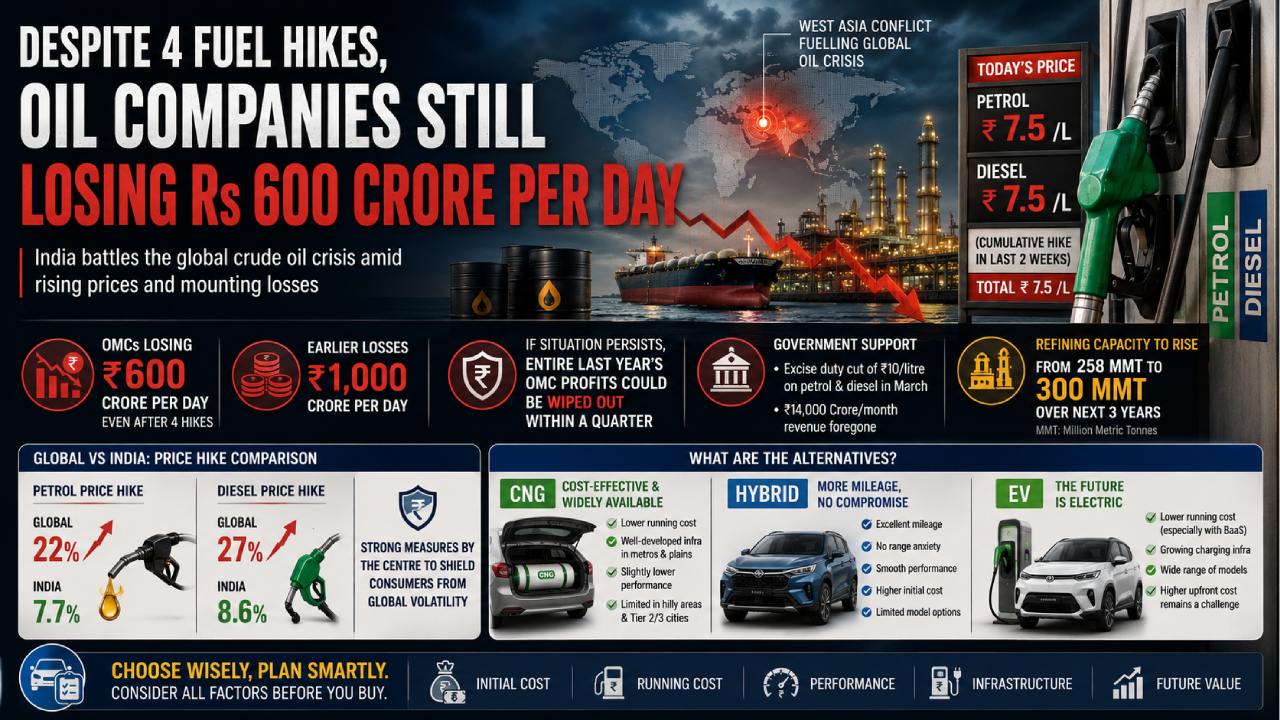
Despite 4 Fuel Hikes, Oil Companies Still Losing Rs 600 Crore Per Day
At the recent inter-ministerial press briefing on the West Asia conflict on Monday, the Joint Secretary at the Ministry of Petroleum and Natural Gas, Sujata Sharma, revealed the specifics of the current situation. In the last two weeks, the cumulative increase in petrol and diesel prices amounts to Rs 7.5 per litre. Nevertheless, she said that the Oil Marketing Companies (OMCs) are still incurring losses of Rs 600 Crore every day. Interestingly, this is still better than what they had to face before the latest price hike. Previously, these losses were Rs 1,000 Crore per day.
Furthermore, she mentioned that if the present situation prevails, the entire last year’s OMC profits will be wiped out within a quarter. That is an alarming situation. She also remarked, “India’s OMCs are an asset to the country; whatever profits these companies earn are distributed among the government as tax, which is being used for welfare, while remaining profits are being used for capital expenditure (CAPEX) purposes.” Also, due to this CAPEX, the country’s refining capacity is expected to go from 258 million metric tonnes to 300 million metric tonnes over the next three years. Hence, it is imperative to ensure that the losses are contained and profits are generated.
What is critical to note is that the motor spirit prices have not gone up so extremely as in other countries. The Joint Secretary also confirmed that the prices have gone up 22% for petrol and 27% globally, while in India, these figures are just 7.7% and 8.6%, respectively. Therefore, one must study these aspects in comparison to the global situation. This happened due to concrete measures from the Centre, including things like the reduction of excise duty by Rs 10 per litre on both petrol and diesel in March. Due to this, there was a loss of around Rs 14,000 Crore per month. Hence, the government tried to shield the consumers before announcing price hikes.
The case with the LPG cylinders is also somewhat similar. However, we would only concern ourselves with the petrol and diesel price hikes at this moment. A situation like this fuels the discussions about alternative fuel sources. These include things like CNG, electric and hybrid powertrain options. It is clear that the fuel prices are most likely never going to go below a certain amount. With the ever-increasing inflation, the prices will keep on rising with time, regardless of how hard the government tries to control. Hence, owning ICE cars will remain an expensive affair.
What Alternatives Are Available?
Currently, CNG is among the most attractive options for a vast majority of car buyers, particularly in large cities and plain areas. The infrastructure in large cities is fairly developed. People are used to the idea since many individual and commercial operators have already been using CNG cars for many years now. The few compromises that the owners have to make are lower power and torque figures, which leads to a slight compromise in terms of performance, a slightly smaller boot compartment despite the new-age packaging technique like dual-cylinder technology, usage in Tier 2 and lower cities or using the CNG car in hilly areas.
The other option is to purchase strong hybrid petrol cars. These offer much higher mileage than diesel cars and there is no specific compromise. The only issue is the high initial cost and limited models on sale. Finally, EVs continue to be more attractive in terms of finances (especially after the introduction of the BaaS model), variety of models, charging infrastructure, etc. Still, the initial prices continue to be high in comparison to the corresponding petrol version. In any case, one must choose wisely while taking all factors into consideration before purchasing a new car and planning ownership costs.
Editor’s Note
Yatharth Chauhan, Managing Editor
Having tracked the Indian fuel market and automotive industry closely, I believe this situation once again highlights how heavily India still depends on global crude oil dynamics. Even after multiple fuel price hikes, the continued losses faced by oil companies show the scale of pressure the entire energy ecosystem is currently under. What stands out to me is that such crises inevitably accelerate conversations around alternative mobility solutions like hybrids, CNG and EVs. In my view, Indian consumers will now increasingly factor long-term running costs and fuel dependency into their purchasing decisions rather than focusing only on the initial price of a vehicle.
Also Read: How Gadkari’s E85 and E100 Rollout Can Be A Nightmare