

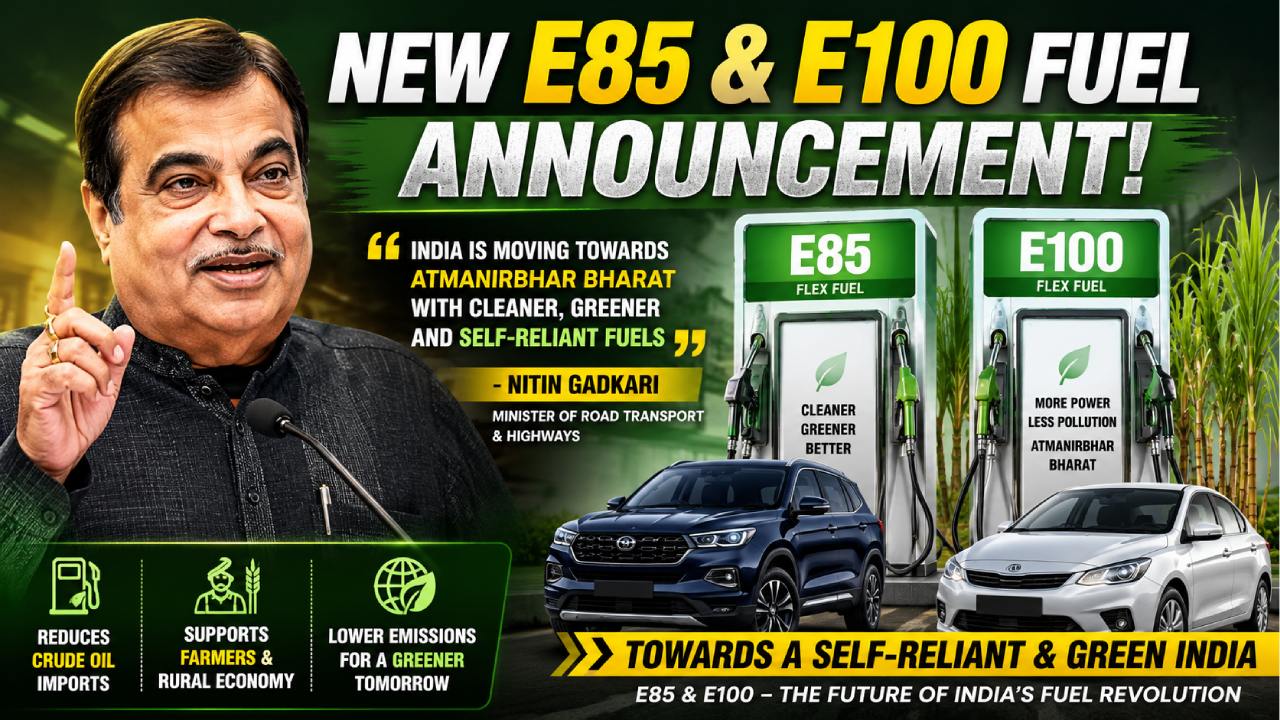
The Indian government is preparing some disruptive technologies for the automobile industry
The details about the E85 and E100 have been circulating around on the internet as Nitin Gadkari, the Minister of Road Transport and Highways, keeps announcing new plans. In recent times, we have seen Nitin Gadkari launch some truly ambitious projects and complete them across the nation. These included things like constructing challenging highways across a diverse range of terrains to ease transportation and reduce travel times between prominent points. This ensured that the journey time of regular individual car owners is reduced, as well as that of commercial operations like cabs, taxis, trucks, lorries and delivery vans. However, currently, he is planning to transform the fuel industry of India.
How Gadkari’s E85 and E100 Rollout Can Be A Nightmare
For the uninitiated, E85 or E100 refers to 85% and 100% Ethanol blend in regular petrol, respectively. You might already be aware of the E20 fuel, which is available across the petrol stations in the country today. As you would expect, it contains 20% Ethanol content. Now, there are some distinct advantages to using this blend. Firstly, the addition of Ethanol reduces the crude oil imports because less petrol is needed. Secondly, Ethanol is produced using surplus sugarcane, maize and other such crops. Hence, the internal economy gets a boost and the farmers can also benefit. Finally, the tailpipe emission is also there, even if it is marginal. However, while considering high quantities of Ethanol like E85, E100 or even E30, there can be a lot of challenges on multiple fronts.
Challenges of E85 and E100 Fuel
When such high quantities of Ethanol is mixed with petrol, the cars are called flex-fuel cars. Now, the energy density of Ethanol is much lower than petrol. As a consequence, this will directly impact performance and fuel economy. Then there is the issue of whether the existing cars are compatible with this fuel. This is where things start to get a little complicated. In fact, you might already have seen the posts online related to people complaining about unusual wear and tear in their cars, reduced mileage and other issues. These are exactly what we need to understand and address before adopting and embracing this new idea.
Water-Intensive Production Process
Another prominent issue is the enormous consumption of water for the production of Ethanol using sugarcane, maize, rice and other food grains. While it might be great for farmers and the nation’s economy, the water-intensive procedures are hard to service. While it is not exactly clear how much water is actually needed to produce a certain quantity of Ethanol, some industry bodies claim that this number is just 3-5 litres of processed water. This is exactly where things can get a bit misleading.
The real water consumption must be calculated from the time of growing these crops and not during the final production stage. In this regard, multiple government-linked studies estimate that water required per litre of Ethanol is 10,790 litres using rice, 4,670 litres using maize and 3,630 litres using sugarcane. This is the real number, which most of us are unaware of. In fact, most of us might not even know that growing just 1 kg of rice actually requires 3,000-5,000 litres of water. In turn, 2.5 kg to 3 kg of rice is needed to produce 1 litre of Ethanol. In essence, the total water consumed during the entire process is around 10,000 litres. Things are marginally better with sugarcane and significantly better with maize.
Now, this is extremely problematic for a country like India, where groundwater tables are constantly declining and farmers are already facing irrigation shortages. We know that extreme summer even result in droughts in some parts of the nation. Apart from that, some other concerns include things like ethanol transportation and storage. Since Ethanol is more susceptible to corrosion, the pipelines, storage systems, fuel pumps and handling systems must also be upgraded to handle the logistics even if we somehow manage to produce such large volumes of Ethanol after taking care of the water-intensive production issue.
We know that even upgrading the vehicles to comply with the E20 fuel is causing issues for the users. Shifting to higher levels would certainly require inherent changes to the vehicle components from the factory. Then there is the problem of how the old cars will be able to live in a world where Ethanol-blended fuel becomes the norm. In conclusion, a lot of things will need to be sorted before making such a huge jump to E85 or E100 fuel.
Editor’s Note
Yatharth Chauhan, Managing Editor
Having tracked India’s evolving fuel policies and automotive trends closely, I believe the push towards higher ethanol blends is one of the most ambitious transformations the industry has faced in decades. While the long-term goals of reducing crude oil imports and supporting local agriculture are understandable, the practical challenges surrounding water consumption, infrastructure readiness and vehicle compatibility cannot be ignored. What stands out to me is that the transition from E20 to E85 or E100 is not merely a fuel upgrade, but a complete ecosystem shift involving farmers, automakers, oil companies and consumers alike. In my view, unless this transition is implemented gradually with proper technical groundwork and public awareness, it could create serious reliability and ownership concerns for millions of Indian vehicle owners.
Also Read: E22/E30 Petrol Ethanol Blend Standards Notified – Everything You Should Know!